
A plain guide to copy trading.
Copy trading lets the trades of a strategy provider be repeated on your account. This site reads the public pages of cTrader Copy and of the regulator, writes down what they say about the machinery, the fees and the risks, and dates every reading. Latest reading: 6 November 2026. It does not tell you whether to copy anyone.
Three ways into the subject
1How the copying worksEach copied trade follows the ratio of two equities. What cTrader's own help pages say, step by step, and the 24 copy-enabled brokers on its list.2What it costsThree fee types, each with a cap printed on the help page (40%, 10% and USD 10 per million), with the help page's own worked example.3Where losses come fromThe small curve on 20 strategy cards, over 29 days, against the return printed beside it: 5 of the 20 curves end below zero.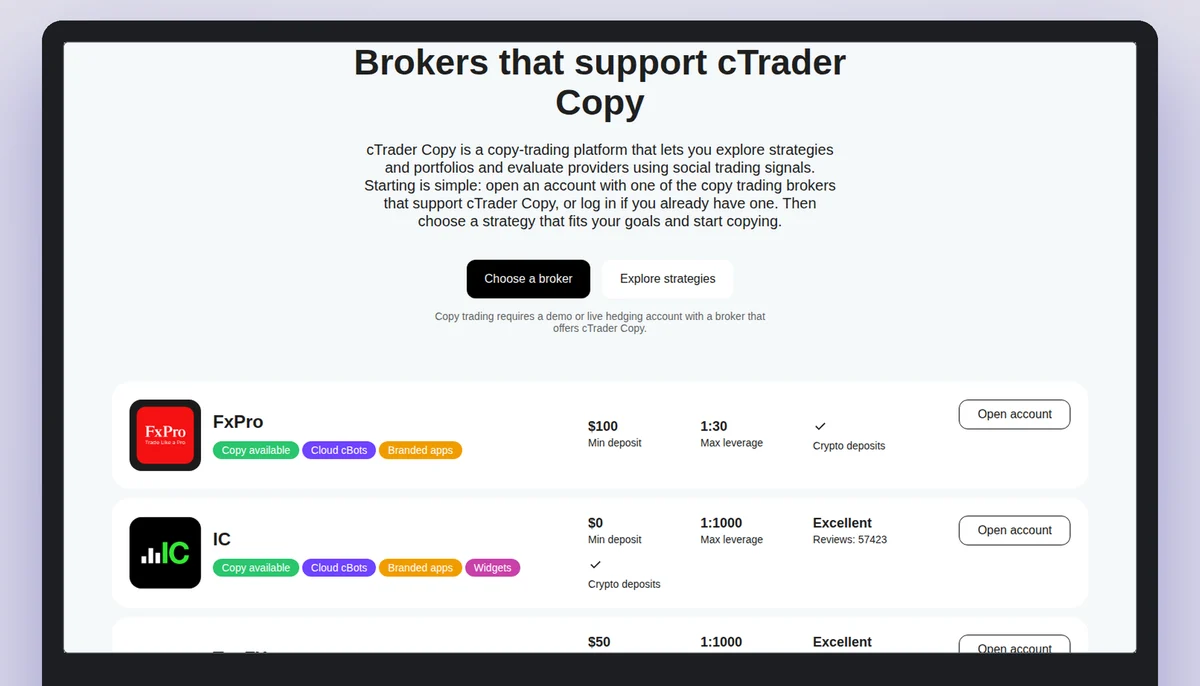
Six questions about copy trading, answered from public pages
- How copying worksThe follower's account repeats the provider's positions in proportion to the two equities; the help pages describe each step.
- Leader and follower pricesThe platform says the two sides' prices may differ because of conditions and execution time. What that means in practice.
- Who charges whatPerformance, management and volume fees, their printed caps, and the help page's worked example.
- How a copy account losesLeverage, margin and the way a card's curve can sit below zero while the printed return is large.
- Small account, big accountMinimum investments on 20 cards run from USD 100 to USD 50,000; what the minimum does to the follower.
- FSCA and copy tradingWhat a scan of 1,148 FSCA news titles found, and how to look a firm up.
What this site is, and the one thing it does
Copy Trade Notes SA reads public pages about copy trading and writes down what they say. The main source is cTrader Copy, the copy-trading service that sits on the cTrader platform: its public front page, its list of brokers, its three symbol pages and its help pages. The second source is the news list of the South African regulator, the Financial Sector Conduct Authority. Every figure on this site is a reading of one of those pages and carries the day it was read. The latest reading was 6 November 2026.
The site is not a broker and does not hold money. It takes no side for or against copy trading, and it does not say whether you should copy anyone. Where a page was silent, this site says that it was silent instead of filling the gap.
What copy trading is, in four sentences
A strategy provider trades on their own account. A follower allocates money to that strategy. The platform repeats the provider's trades on the follower's account, sized by the ratio of the two equities. The follower can stop at any time, and the provider may be paid by fees the platform takes from the follower's account. Everything else on the site is detail about those four sentences.
What the broker list showed
The page of brokers on ctrader.com held 53 broker entries on 6 November 2026, and 24 of them carried the copy flag that the page prints as "Copy available". Of those 24, 10 print no regulator at all, and 3 name the South African authority among theirs. For FxPro, the broker this site links to, the list printed a copy flag, a maximum leverage of 1:30, a minimum deposit of USD 100 and the regulators FCA UK; SCB - SIA Bahamas.
What the 20 strategy cards showed
cTrader's pages for gold, bitcoin and the euro show the same 20 strategy cards. Their ages run from 49 days to 1,369 days, and 12 of them are under a year old. The printed returns run from -17% to 113,998%, and 8 are 1,000% or more. 15 of the 20 trade gold. Next to each return a small curve of 29 daily points is drawn, from 8 October 2026 to 5 November 2026. 5 of the 20 curves ended below zero. The cards do not state the period of the printed return, which is why this site never calls it a result for any reader.
What the fees can be
The help page names three fees and prints a cap for each: a performance fee of at most 40% of net profit, a management fee of at most 10% of equity a year, and a volume fee of at most USD 10 per million copied. Its worked example, USD 1,000 allocated, gives a performance fee of USD 70 on USD 700 of profit and a management fee of USD 50 a year. All fees are charged on the 1st of the month and when the investor leaves.
Why the follower's result is not the provider's
The platform says it itself: provider and investor prices may differ because of trading conditions and execution time. Beyond prices, the follower pays fees the provider's record does not include, the sizes are recalculated when either side adds or removes funds, and a follower with lower leverage may reach stop out earlier. None of these has a figure on the pages this site read, so none has one here.
What the regulator's page showed
This site read the title list of the FSCA's news page on 6 November 2026: 1,148 rows and 736 different titles. None contains "copy" or "mirror". The list is mostly public warnings and licence notices. A title scan does not read the documents, so this is a gap in what this site found, not a finding that the regulator is silent.
What this site did not do
It did not log in anywhere. Strategy pages with fees, drawdown and trade history sit behind the application, and this site read none of them. It did not open an account, copy a strategy or measure a fill. It does not publish a ranking of providers, a return a reader could expect or a list of strategies to follow. A site that did would be advertising, and the reader would be the one holding the risk.
What the strategy list leaves out
The help page on the strategy list says: "The strategy list only includes strategies whose providers are currently trading." A strategy whose provider has stopped is therefore not on that list. The list cannot show how many strategies started and ended, and a page that counts only the ones still running cannot say what share of all strategies lost money. That is a limit of the source, and every count on this site inherits it: they describe the cards shown on the day they were read and nothing about the strategies that are no longer there.
What the broker entries print about regulators
Among the 24 copy-flagged entries, the regulators named, in the list's own short names and with the number of entries naming each, were CYSEC (7), FSA Seychelles (4), FCA UK (3), ASIC (3), FSC Mauritius (3), FSCA South Africa (3), ESMA (3), SCB - SIA Bahamas (2). 10 entries print none. These are the list's words, not a check against any regulator's register, and a name on the list says nothing about whether a South African resident is served under that authorisation. On leverage, 3 of the 24 entries print 1:30 as their maximum and 18 print 1:500 or more.
How varied the 20 cards are
11 of the 20 cards list a single symbol and 3 list four or more, up to 10. Their minimum investments run from USD 100 to USD 50,000, as the page on account size sets out. Nothing on the cards tells a reader how a strategy trades; the symbol list only says what it has traded. This site does not group the cards by style, because the pages give no style to group by.
Ages and printed returns read together
4 of the 20 cards are younger than 100 days, 8 are between 100 days and a year, and 8 are a year old or more. Of the 8 cards printing 1,000% or more, 5 are younger than a year. Of the 2 printing a negative return, 2 are younger than a year. Those are counts on twenty cards chosen by the platform for three symbol pages, and the pages do not say how they were chosen, so no pattern is claimed. They show only that a very large printed return and a very short history sit together on this list.
When the readings were taken
The cTrader pages were saved on 6 November 2026 within a few minutes of each other, one request at a time, and the FSCA news page on 6 November 2026. A later reading may differ: brokers are added to the list, cards change their order, and a fee page can be revised. The dates printed beside each figure are the only thing that makes it checkable, and a figure without the date it was read is not published here.
Questions to put to the broker before depositing
The help pages leave several things to the broker. Is the copy service open to a resident of South Africa? Which company holds the account, and under which authorisation? Is the account a hedging account, which copying requires? Can a demo account follow a strategy? What does the "Start copying" button show for the fees of the strategy in question? What is the leverage on the account, compared with the provider's? How does the broker treat a copied position smaller than its smallest tradable size, which the help pages do not describe? And what happens to the funds if the provider stops the strategy? The last one the help page answers: all investors stop copying, open positions are closed and unrealised fees are charged.
How to use what is here
Before copying anyone, find out three things the public pages cannot tell you. What fees the particular strategy charges, which you can see on the "Start copying" button. Whether the broker offers copying to a resident of South Africa, which you ask the broker. And under which company, with which authorisation, the account is held, which you check on the FSCA register against the legal name in the client agreement.
A short glossary
Provider: the trader whose positions are copied. Follower or investor: the account that repeats them. Equity: the account balance with open profit and loss included. High-water mark: the highest value reached, above which a performance fee is charged. Stop out: the broker closing positions because the margin is no longer enough. Contract for difference: a contract on a price, not ownership of the thing priced. Hedging account: an account that can hold opposite positions at once, the kind copying requires.
How a figure on this site is checked
The pages are saved as read, and a second script counts the brokers, the strategy cards, their returns, minimums and dates, and the fall inside each curve from the saved files by a different route. A disagreement is reported as an error. A defect planted on purpose, in each of five places, was caught each time. That checks the copying of the figures. It does not check that the platform's pages are right.
The broker this site links to
This site links to FxPro, which cTrader's list marks as a copy-enabled broker. A copied trade is a leveraged contract on a price, not ownership of anything. Read the terms before you decide anything.